
Hamilton County Projected Versus Actual
A projected date estimates when a present custody term may end under the sentence and credits then on record. FDC labels its public field Current Release Date. Florida law calls the underlying calculation a tentative release date. Neither label records an exit that already happened. An actual state-prison release is confirmed later through FDC Inmate Release Information, where a past Release Date and Date Out-Custody show that the incarceration episode ended.
County custody uses a different record. Hamilton County Jail View displays an exact Released timestamp only after the HCSO booking has closed. A future court event, bond amount, estimated sentence end, or name disappearing from the current roster does not establish that event. A transfer can end HCSO custody while the person remains held by FDC, another county, USMS, or ICE.
- Current Release Date
- The public FDC label for a presently calculated, changeable date on an incarcerated profile.
- Tentative release date
- The statutory Florida calculation after lawful credit and applicable gain-time changes.
- Date Out-Custody
- The FDC history field showing that a particular state incarceration episode ended.
- Detainer
- A request or hold from another authority that can affect what happens when one custodian releases a person.
Find Hamilton County Projected Release Dates
Begin with the system that now holds the person. Hamilton County includes a county jail operated by HCSO and a state-prison complex operated by FDC. Their date fields do not substitute for one another. The FDC Inmate Population Search covers sentenced state prisoners. It does not cover a local jail sentence, county probation, or a person awaiting trial in Hamilton County Jail.
The following sequence keeps the two custody paths separate.
- Identify whether the person is at Hamilton County Jail, in an FDC institution, or held by another custodian.
- For FDC custody, search by the six-character DC Number when known and open the matching current detail.
- Read the field exactly as Current Release Date. Keep any TO BE SET or SENTENCED TO LIFE label intact.
- For a county sentence, ask HCSO for its sentence and release computation, using the booking or MNI number.
- For a pretrial case, read the Hamilton Clerk docket for bond and release orders without converting a court date into an exit date.
- After the projected day, check the proper released record for the actual out-custody event.
The Hamilton County released inmate search path explains how to combine Jail View, the Clerk docket, FDC, and receiving-agency records after an exit. For a pending custody notice, the Hamilton County VINELink check can add an alert, but VINE should not be the sole proof of release.
Review the official FDC Current Release Date schema example to see how the field is presented.
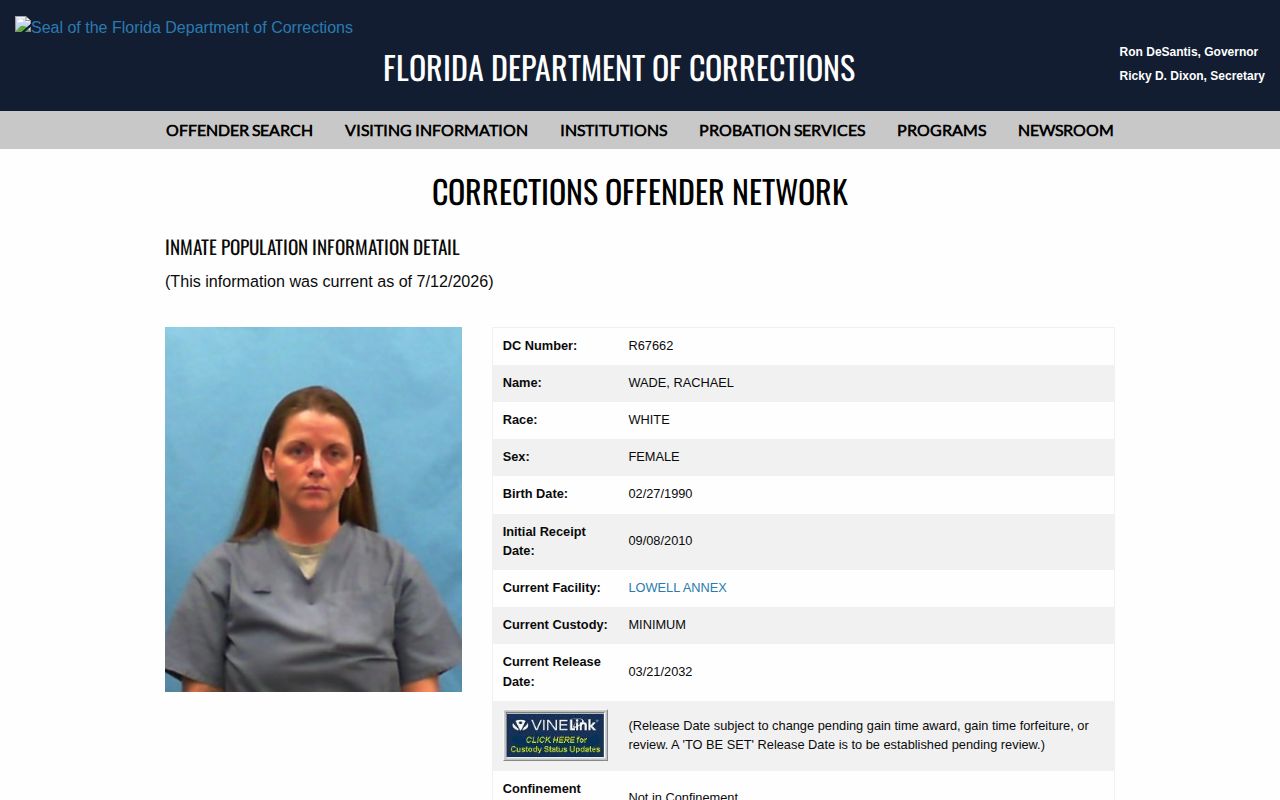
The example supplies field evidence only. It is not a featured-person profile, and the warning on the live FDC record governs interpretation.
Note: A future FDC date does not place a person on a Hamilton County recent-release list or prove an actual exit.
Florida Prison Release Date Math
Under Florida section 944.275, FDC first establishes maximum sentence expiration from the imposed term or combined terms, less lawful credit. It then establishes the tentative release date. Gain-time that is granted or restored may move the date earlier. Forfeited gain-time can move it later. A new sentence imposed before release can require both dates to be set again. An escape or parole-violation return may also change the calculation for time outside custody and any new term, subject to lawful credits.
Offense date controls the gain-time framework. Basic gain-time applies to offenses from July 1, 1978 through December 31, 1993. Incentive rules vary across older date bands. For offenses on or after October 1, 1995, the statute generally permits up to 10 days of incentive gain-time per month, subject to exclusions. Some offenses are not eligible. Meritorious and certain educational awards have separate rules. The FDC Rule 33-601 chapter supplies related administrative rules.
For the post-October 1, 1995 group, section 944.275(4)(f) bars gain-time that would cause release before 85 percent of the imposed sentence has been served. Court-awarded credit for time physically incarcerated counts toward that floor. It is not a promise of release at 85 percent. A mandatory minimum, excluded offense, forfeiture, added or consecutive sentence, and legal review can require more time. A life sentence remains life unless lawful clemency or pardon changes it.
Read the official gain-time statute alongside the FDC date rather than relying on an outside calculator.
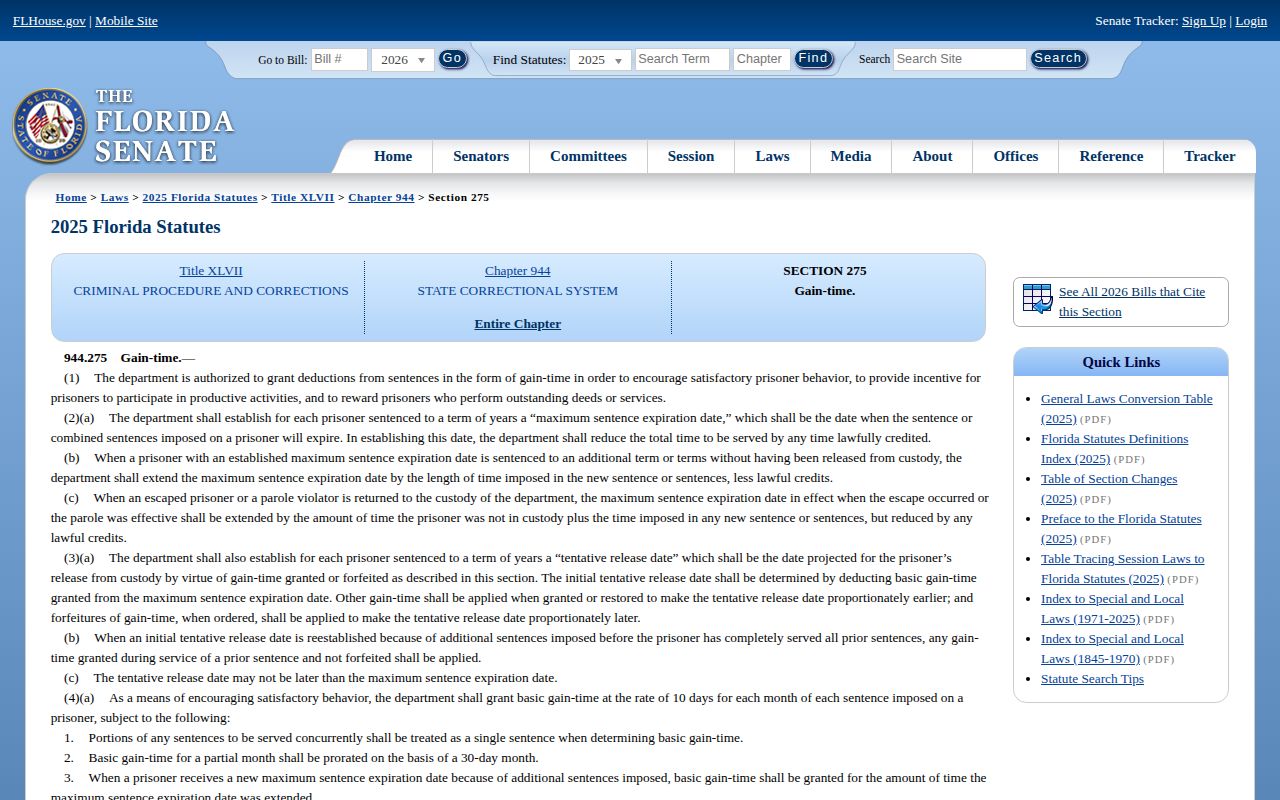
The statutory text explains the calculation rules, while FDC holds the current sentence, credit, discipline, and award data needed for an individual date.
Hamilton County Jail Release Math
A Hamilton County Jail sentence is not calculated through the FDC prison date field. Florida section 951.21 authorizes county-prisoner good-conduct commutation, but it also permits the county commission to discontinue or revise that policy. The statutory schedule, when authorized, allows up to five days per month during years one and two, ten days during years three and four, and fifteen days during later years. Misconduct can affect the credit.
No official Hamilton implementation decision or local calculation page was located. Therefore, the statutory maximum must not be applied as if every Hamilton County prisoner earns it. Ask the HCSO Public Records Division for the sentence and release computation tied to the booking number, MNI number, sentence, and case. The Hamilton Clerk judgment can establish the imposed term and jail credit, but it may not show HCSO's final physical release time.
A person held before trial has no sentence-based projected date. Bond, a judge's order, case disposition, and holds determine whether and when the jail may release that person. The Third Judicial Circuit bond schedule can govern pre-first-appearance bond eligibility, but it does not compel prerelease and does not bind a judge's individual ruling. An amount shown in Jail View is not a release prediction.
Ask for the calculation in terms the custodian can answer from an existing record: the imposed county sentence, jail credit, any authorized good-conduct credit, maximum end date, holds, and the current expected release date if maintained. HCSO need not create a new forecast or solve a hypothetical. A narrow request tied to one booking and court case is more likely to separate the sentence calculation from unrelated charge or bond history.
Note: Hamilton County has no sourced local good-time calculator, so HCSO must confirm any county-sentence release computation.
Hamilton County Release Date Changes
A date may move because the facts used in the calculation change or because another legal restriction controls release. The live custodian record is more reliable than an estimate made from a sentence length alone. The court judgment, offense date, concurrent or consecutive structure, time-served credit, and statutory eligibility all matter.
| Factor | Possible effect | Record to check |
|---|---|---|
| Gain-time award or restoration | May move a tentative FDC date earlier within legal limits | FDC Current Release Date and calculation record |
| Gain-time forfeiture | May move the date later | FDC sentence and discipline calculation |
| Added or consecutive sentence | Can require expiration and tentative dates to be reset | Court judgment and FDC detail |
| Detainer or hold | May cause transfer to another custodian after release | Jail holds, release disposition, receiving system |
| Parole or conditional-release action | May set, change, defer, revoke, or attach supervision to release | FCOR or FDC final order |
| Pending review | May appear as TO BE SET rather than a date | FDC current detail and classification contact |
FDC's own warning says the Current Release Date can change because gain-time is awarded, forfeited, or reviewed. A PPRD from a parole process is also not an actual release. When records conflict, preserve the access date and exact field labels. Ask the agency that owns the disputed date to explain or correct it.
Hamilton County Dates and Supervision
Leaving prison on a tentative date can begin conditional release or another form of community supervision. It does not always end legal oversight. After FDC shows a past Release Date and Date Out-Custody, search the Supervised Population database. Read the current status, office, and termination information for the same DC Number. The Lake City Circuit Office serves Hamilton County when a state supervision entry needs telephone confirmation.
Parole records require added care. FCOR agendas list scheduled matters but are not a decisions database. A presumptive parole release date or hearing date remains projected. The final commission action or order, followed by the FDC custody record, supplies the sound sequence: authorized or scheduled action, actual out-custody date, and any supervision that followed.
A supervision termination date answers a later question than the prison release date. Someone can be outside prison while still reporting to FDC, subject to community control, or bound by an FCOR order. Keep both dates with their labels. If a future prison date changes, the supervision start may change too, but the public record should not assume that result before the custodian posts the actual events.
Confirm Hamilton County Actual Release
For Hamilton County Jail, select Released Inmates Only in HCSO Jail View and seek the exact released timestamp for the correct booking. Inspect holds. The portal has no dedicated public release-reason field, so ask HCSO for the release disposition and receiving agency when the difference between community release and transfer matters.
For a Florida state prisoner, use FDC Inmate Release Information. A past Release Date and Date Out-Custody within that database confirm departure from FDC custody. Then check supervision. A move between Hamilton Correctional Institution Main Unit, the Annex, or another FDC prison is a transfer and remains custody. It does not create an out-custody release.
VINELink may send a custody alert, but agency processing can cause delay. A no-result is also inconclusive. Keep the alert as supporting evidence, then confirm the event with HCSO, FDC, the court, or another receiving custodian. This final check turns a projection into a documented custody timeline.